Digital Transformation Is an Architectural Project
Digital transformation in automotive logistics is not primarily a software problem. It is an architectural problem: the hidden structure of authority, decisions, and coordination that technology ultimately mirrors.
Digital transformation in automotive logistics is usually framed as a technology initiative. A new transport management system replaces a legacy platform. A yard management tool is introduced to reduce congestion. A visibility layer promises end-to-end tracking. Data lakes are built. Automation pilots launch.
These projects are expensive, disruptive, and symbolically important. They are treated as milestones — the moment an organization becomes modern.
Yet outcomes remain inconsistent. Systems integrate unevenly. Workarounds proliferate. Planning improves without stabilizing execution. Visibility increases without reducing uncertainty. Complexity expands instead of contracting. Leaders sense progress in pockets, but not across the network.
The typical explanation is execution failure: poor change management, vendor misalignment, insufficient training. These factors matter. But they assume the transformation failed because it was implemented badly.
A more difficult conclusion is that many transformations fail because they are misdefined from the start.
Digital transformation in automotive logistics is not primarily a software problem.
It is an architectural problem.
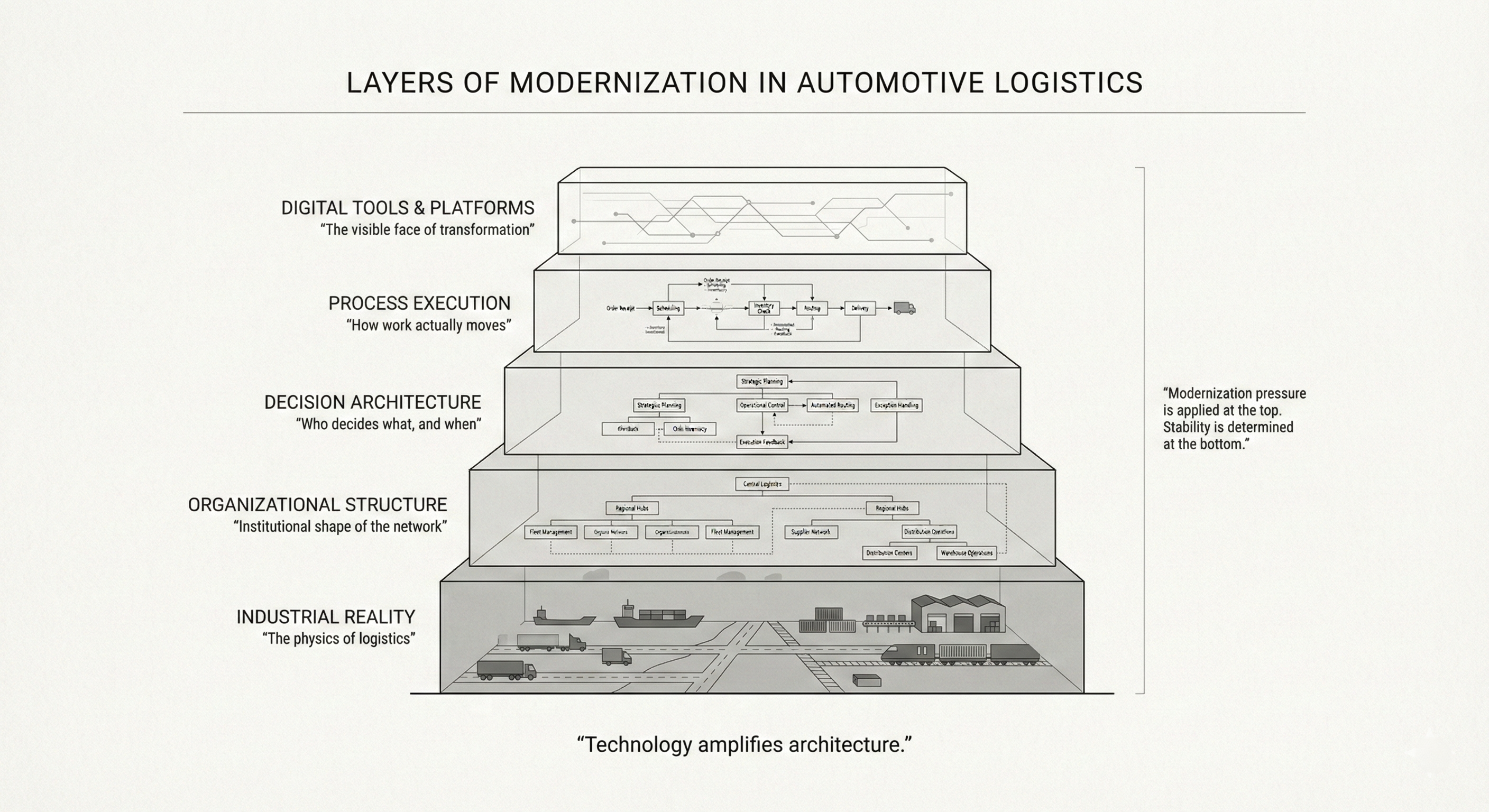
The invisible structure beneath operations
Every automotive logistics organization already operates on an architecture. Not a technical architecture, but an operational one: a layered system of authority, decision flow, information ownership, escalation paths, and informal coordination.
This structure is rarely designed in a single moment. It accumulates over decades through plant expansions, mergers, regional autonomy, crisis responses, and local optimizations. It reflects historical compromises as much as strategic intent.
Technology enters this environment as a guest.
Consider a common scenario: a global OEM introduces a unified transport management system across regions. The expectation is harmonization. In practice, each region configures the system to match existing workflows. Local carrier relationships, contract structures, and exception handling rules are preserved. The software standardizes the interface but inherits the fragmentation underneath.
From headquarters, the rollout appears successful. A single platform is in place. Internally, the organization continues to operate as a federation of semi-independent systems — now connected by shared software that encodes their differences.
The digital layer mirrors the architecture it enters.
If the underlying structure is fragmented, the system will digitize fragmentation.
Component optimization versus system design
Most modernization programs target components. A plant implements automated yard scheduling to reduce dwell time. A parts distribution center upgrades its warehouse execution system. A supplier portal digitizes ASN flows. Each initiative delivers measurable local gains.
But automotive logistics is not a chain of isolated components. It is a tightly coupled network where upstream decisions ripple into downstream consequences.
A plant that accelerates inbound scheduling without synchronizing supplier release patterns can shift congestion upstream. A distribution center that optimizes picking speed can overwhelm line-haul capacity. A visibility platform that exposes delays without redistributing decision authority simply creates more alerts for the same people to absorb.
Local efficiency can coexist with global instability.
Without architectural intent, modernization becomes additive. Each improvement increases system surface area: more interfaces, more integration points, more coordination overhead. Experienced operators become translators between platforms. Informal human work stabilizes the gaps.
From a distance, the infrastructure looks advanced. On the ground, it is sustained by institutional memory and improvisation.
Architectural thinking asks a different question. Not “Which component should we upgrade?” but “What structure allows the network to behave coherently?”
That question shifts modernization from procurement to design.
Architecture as a leadership discipline
Treating transformation as architecture redefines the role of leadership. The challenge is no longer sponsoring projects; it is shaping system logic.
Architectural decisions determine:
- where planning authority resides between plant, region, and central functions
- how exception management is distributed
- which data is authoritative and where it originates
- how cross-functional trade-offs are resolved
- how the network absorbs shocks such as plant shutdowns or port disruptions
- what is standardized globally versus adapted locally
These are organizational design choices expressed through technology. When they remain implicit, software crystallizes historical compromises. When they are explicit, technology reinforces deliberate structure.
Legacy systems in automotive logistics often feel constraining not only because they are outdated, but because they embody an earlier architecture: assumptions about regional autonomy, supplier integration, or plant independence that no longer match current scale. Replacing the platform without revisiting those assumptions reproduces the constraint in modern form.
Transformation succeeds when architecture leads and technology follows.
Complexity and the illusion of progress
Automotive supply networks operate under escalating complexity: platform proliferation, just-in-sequence production, electrification transitions, geopolitical risk, and volatile demand patterns. Technology promises to tame this environment. In poorly designed architectures, it converts complexity into fragility.
Each additional layer — visibility tools, predictive analytics, automation islands — introduces new dependencies. Interfaces multiply. Responsibility diffuses. When disruptions occur, organizations rely on a small number of experienced coordinators who manually reconcile data, negotiate priorities, and stabilize flow.
These individuals function as living integration layers.
Their effectiveness masks architectural weakness. As long as they are present, the system appears resilient. When they leave or scale is exceeded, fragility surfaces abruptly.
Architectural modernization aims to reduce reliance on invisible heroics. Its success is measured not by the number of platforms deployed, but by systemic legibility. Can leaders trace how a schedule change propagates through plants and suppliers? Can teams predict how the network behaves under stress? Can the organization scale volume without proportionally scaling coordination effort?
These are architectural outcomes.
From projects to systems
Reframing digital transformation as architecture does not diminish technology; it situates it. Software, data infrastructure, and automation remain essential. But they operate inside a designed system rather than a historical accident.
This shift requires a longer temporal horizon. Projects have deadlines. Architecture has a trajectory. Each modernization effort becomes part of a coherent sequence of design decisions. The organization builds toward a system, not a collection of upgrades.
Companies that adopt this perspective stop chasing transformation as an event. They treat modernization as an ongoing architectural practice. The central question changes from:
“When will we be transformed?”
to:
“What system are we intentionally building over time?”
That question slows decision-making in the short term. It produces stability in the long term.
The deeper promise of modernization
Digital transformation is usually justified through efficiency, visibility, and cost. These are operational outcomes. The deeper promise is cognitive.
A well-architected logistics system becomes understandable. Leaders can reason about it. Decisions produce predictable consequences. Trade-offs are visible rather than hidden in interfaces. Complexity remains, but it is navigable.
In that environment, technology is not a patchwork layered onto operations. It is an expression of coherent industrial design.
Transformation then ceases to be a cycle of disruption followed by recovery. It becomes a disciplined process of shaping infrastructure.
That is a more demanding ambition than modernization through tools.
It is modernization through structure.
And structure, once clarified, compounds.